The Black Madonna of Montserrat: History, Legend and Meaning
See prices From 39 EUR · Free cancellation available
Contents
The montserrat black madonna, known across Catalonia as La Moreneta, is a seated wood carving of the Virgin holding the Christ child, both finished in a deep, near-black patina that gives her the nickname. Here’s what I’d actually do before anything else on a Montserrat trip: decide whether seeing her up close matters to you, because that single choice shapes which ticket or tour makes sense for the rest of the day.
She sits inside the Basilica of the monastery, which every option in our Montserrat tickets guide includes in some form, though not every one pre-books time behind the altar to see her. The attribute that actually separates these products from each other is how long each one keeps you at the mountain, so seeing how long each Montserrat tour actually runs is worth doing before you commit to a date, and every Montserrat tour and ticket compared here is the starting point for that comparison.
Who Is the Black Madonna of Montserrat?
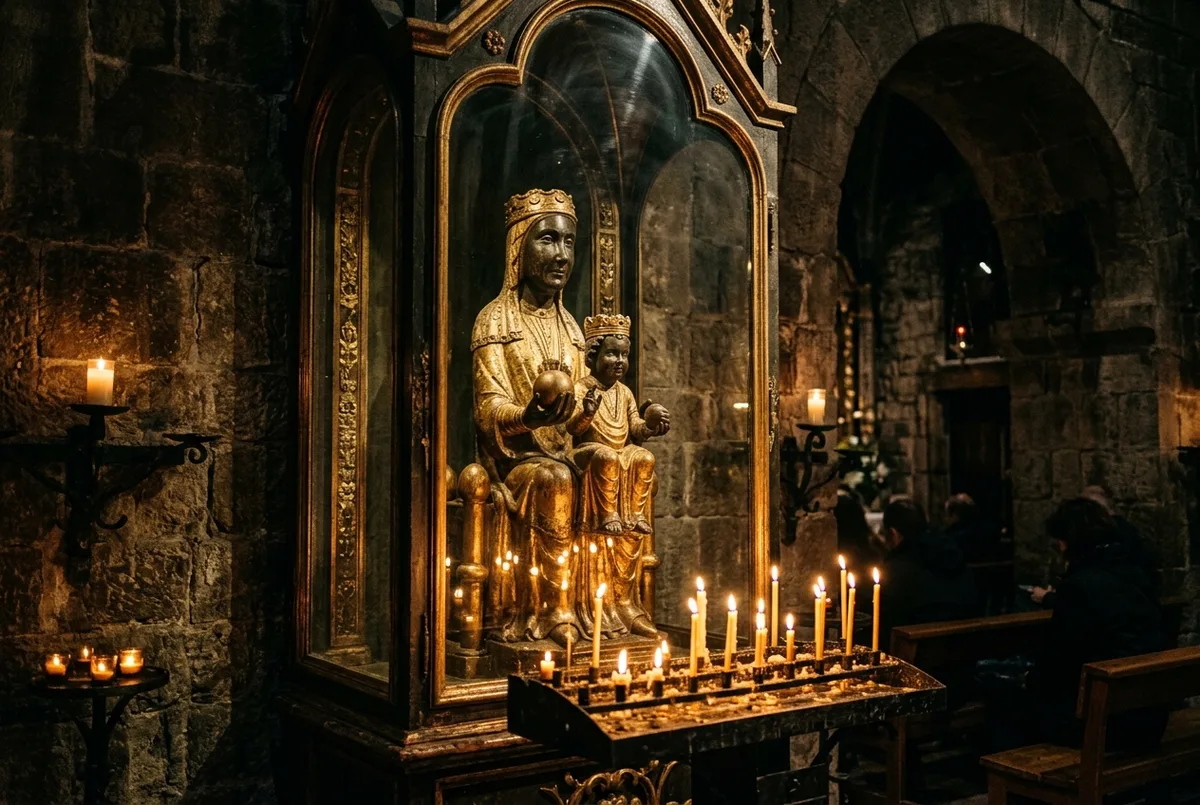
La Moreneta is a Romanesque carving of Mary seated on a throne with the infant Jesus on her lap, both rendered in the same dark wood tone. She is not a painting or a relic in the usual sense; she’s a three-dimensional statue, roughly three feet tall, that pilgrims have climbed a mountain to see for centuries.
I’d push back gently on the word “mysterious” that shows up in a lot of writing about her. She is well documented, housed in a specific chamber behind the main altar, and visited by a huge number of ordinary travelers every week, not just pilgrims. The mystery, if there is one, is really just how little most visitors know about her before they arrive.
Check prices & dates
Ready to visit?
Book your tickets in advance: popular time slots sell out.
What Artistic Style Does the Black Madonna Follow?
She belongs to a style art historians call the Majestat, a seated, frontal pose common to Romanesque Marian carvings across Catalonia and wider Europe in the 11th and 12th centuries. The pose is formal and symmetrical by design: Mary sits upright on a throne-like seat, the Christ child centered on her lap, both facing straight ahead rather than angled toward each other the way later Gothic and Renaissance Madonnas often are.
I’d notice the orb in the child’s hand if you get close enough, a small sphere visitors traditionally reach out to touch. The carving is wood, polychromed originally in brighter tones before centuries of smoke and varnish settled into the dark patina she’s known for now. Knowing the style helps explain why she looks different from, say, a Baroque church statue you might have seen elsewhere in Spain; our lady of montserrat statue is deliberately older and plainer in form, and that plainness is part of the point.
Why Is the Statue Black?
This is the question I get asked most, and the honest answer is less dramatic than the legends that have grown around it. Centuries of candle smoke, the natural darkening of varnish over time, and the aging of the wood itself are the explanation most art historians and the monastery itself point to, not an intentional choice by the original carver.
I wouldn’t dismiss the folklore around it either, since it’s part of why the devotion is so strong, but I’d separate “why visitors find her striking” from “why she’s actually dark.” The patina is a material fact. The meaning people have attached to it over nine centuries is a separate, much richer story, one our legend and miracles page covers in full.
How Old Is the Black Madonna Statue?
Most scholarship dates the current carving to the 12th century, placing it among the broader European tradition of Romanesque black madonnas found across France and Spain. The monastery itself traces its own founding earlier still, to the 11th century, as a Benedictine community built up around the site where the statue was already venerated.
My honest take: the exact date matters less than the continuity. This is a statue that has sat in roughly the same spot, in some form of chamber or chapel, for the better part of a millennium, through wars, a 19th-century destruction of the original monastery buildings, and a full reconstruction. That’s the detail I find more striking than any single date. The Santa Maria de Montserrat entry covers that reconstruction history in more depth if you want the fuller timeline.
Is the Statue You See Today the Original 12th-Century Carving?
Yes, by most accounts, which is genuinely remarkable given everything the monastery has survived. The original monastery buildings were largely destroyed during the Napoleonic Wars in the early 1800s and again disrupted during the Spanish Civil War in the 20th century, yet the statue itself is understood to have survived both periods largely intact, sometimes moved or hidden for safekeeping rather than lost.
I find that survival story more compelling than the legend alone. A lot of what visitors see at Montserrat today, the basilica’s current form, the monastery buildings around it, is a 19th and 20th-century reconstruction. The black madonna of montserrat spain is one of the few pieces of the site with a real claim to physical continuity stretching back to the Romanesque period, and I think that’s worth knowing before you stand in front of her.
Why Is She Catalonia’s Patron Saint?
Pope Leo XIII formally declared Our Lady of Montserrat the patron saint of Catalonia in 1881, cementing a devotion that long predated the official title. Catalans had already been climbing this mountain for her for centuries by that point, through pilgrimages, royal visits, and a steady stream of ordinary families marking births, weddings, and recoveries from illness in her name.
I’d frame this less as a single papal decision and more as paperwork catching up to a few hundred years of lived tradition. The black virgin of montserrat isn’t just a Catholic religious figure in Catalonia; she functions as a symbol of regional identity that shows up in everything from naming conventions to political movements over the past century and a half.
Where Exactly Does She Sit Inside the Basilica?
She sits behind the main altar, in a separate chamber reached by a short walk and, on most days, a set of stairs. Visitors move through on a managed, timed basis rather than wandering up at will, which is part of why seeing her closely usually takes some planning rather than happening automatically as part of a basilica visit.
I’d treat the basilica and the close-up Black Madonna viewing as two separate parts of the same stop, because functionally they are. The basilica itself is open and free to enter. The walk behind the altar to stand closest to her is the part that needs either a pre-booked slot through a guided tour or patience in a walk-up queue, which our practical booking guide covers in detail.
What Does “La Moreneta” Actually Mean?
“La Moreneta” translates roughly to “the little dark-haired one” or “the little dark one” in Catalan, an affectionate nickname rather than a formal title. It’s the name most Catalans use day to day, while “Our Lady of Montserrat” or “the virgin of montserrat statue” tends to show up more in formal or English-language contexts.
I’d use whichever name feels natural, honestly. Locals won’t blink if you ask about “the black madonna” in English, and the staff at the monastery are used to the full range of names visitors arrive with.
How Does the Black Madonna Connect to Santa Cova and the Escolania Choir?
The apparition legend tied to this statue is specifically rooted at Santa Cova, a cave on the mountainside below the monastery where tradition holds she was first found. That story, along with the fertility folklore that has grown up around it, is its own deep topic, and our Santa Cova guide walks through it properly rather than compressing it here.
The Escolania, Europe’s oldest boys’ choir, sings in her honor as part of the daily liturgy at the basilica, usually around midday, which is why some visitors specifically time their trip around hearing them. I’d read our Escolania guide if that detail interests you, since the schedule isn’t guaranteed and timing it takes a bit of planning.
Is the Monastery Still an Active Religious Community?
Yes, and I think this is the fact most casual visitors miss entirely. Montserrat isn’t a museum piece preserved for tourists; it’s a working Benedictine monastery with monks living, praying, and working on the mountain today, the same community that has maintained devotion to the Black Madonna across the centuries.
I’d genuinely recommend reading our piece on the monks of Montserrat before your visit, since it reframes the whole site. You’re not just looking at a historic statue in an old building; you’re a guest in an active religious community’s home, and that context changes how I’d suggest behaving while you’re there.
Why Do So Many People Make a Pilgrimage to See Her?
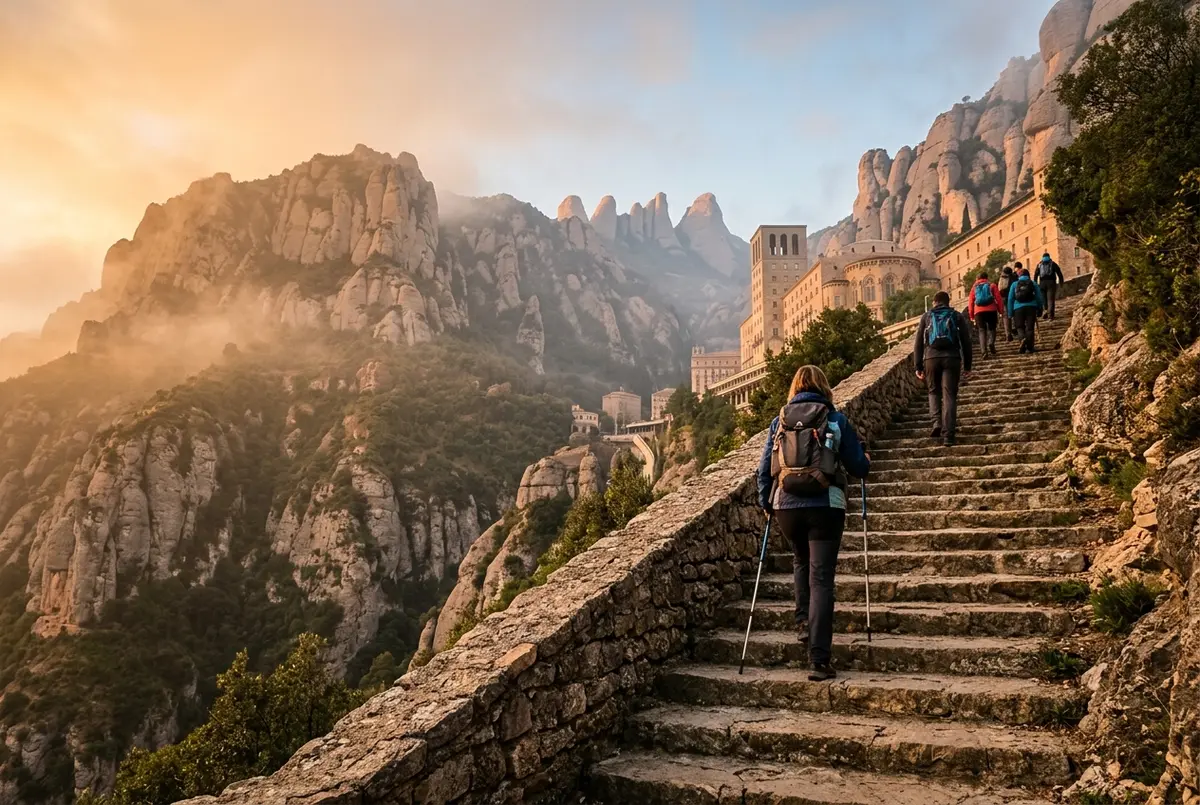
Pilgrimage to Montserrat predates modern tourism by hundreds of years, and the Black Madonna is the reason the mountain became a destination at all rather than just a dramatic rock formation above Barcelona. Royal visits, military victories credited to her intercession, and a steady stream of families marking weddings and births in her name built up a devotion that still brings organized pilgrim groups here today, separate from the day-trippers.
I’d keep this in mind even if you’re coming purely as a tourist: you’ll likely share the basilica with people for whom this visit carries real religious weight. I think that context makes the whole site feel different than a typical monument, and it’s worth a moment of quiet respect even if the history alone brought you here rather than faith.
How Has the Black Madonna Shaped Catalan Culture and Identity?
Beyond her religious role, La Moreneta shows up constantly in Catalan life. Montserrat is one of the most common given names for Catalan women specifically because of her, and the mountain’s silhouette appears on everything from local business branding to regional tourism material. The Virolai, the hymn the Escolania choir sings in her honor, functions almost as an unofficial anthem for devoted Catalans.
My honest read is that you can’t fully separate the religious figure from the cultural symbol at this point; they’ve merged over nine centuries into something bigger than either on its own. If you want to understand Catalonia a little better, not just see a nice statue, I’d say spending real time with her story does more for that than most museum stops in Barcelona manage.
What Should You Expect When You Reach the Chamber Behind the Altar?
The walk to the chamber is short, usually involving a set of stairs, and the space itself is intimate rather than grand, built to bring visitors close to the statue rather than view it from a distance. A single-file, managed flow keeps things moving, so the whole viewing tends to last only a few minutes even with a short line waiting behind you.
I wouldn’t expect a quiet, contemplative moment to linger in, honestly, given how many people move through on a typical day. What you do get is a genuinely close look at a statue most descriptions and photos don’t fully capture, since the dark patina and the carving’s details read differently in person than in any picture I’ve seen of her.
I’d also flag the sensory shift as you move from the open basilica into this smaller space. Light drops, the space narrows, and the ambient noise of a crowded basilica fades into something closer to a hush. That change alone tells you something about how deliberately this part of the visit is staged, not for drama, but to mark the difference between looking at the monastery’s architecture and standing directly in front of the figure the whole place was built around. I’d prepare for that shift mentally rather than let it catch you off guard mid-queue, since it changes the tone of the visit more than most descriptions let on.
Should Seeing the Black Madonna Shape How You Plan Your Visit?
If she’s the reason you’re going to Montserrat at all, yes, I’d build the rest of the day around guaranteeing that access rather than treating it as a nice-to-have. The Montserrat cogwheel, Black Madonna and winery tour offers her as a bookable add-on from EUR 39 for the base tour, which is the option I’d point most first-time visitors toward if a guided day with some flexibility is what you want.
If she’s one stop among several rather than the main event, I wouldn’t stress over it. Free time built into most tours covers a walk-up queue reasonably well outside peak weekends. Either way, I’d read our Montserrat tickets guide next, since it lays out exactly which ticket layer gets you what, Black Madonna access included or not.
Frequently Asked Questions
Is the Black Madonna of Montserrat the same as other black madonnas in Europe?
She belongs to the same broader Romanesque tradition as other black madonnas found across France and Spain, but each has its own specific history and legend. La Moreneta’s story is tied specifically to Montserrat and Catalonia rather than shared with any other statue.
Do you have to be Catholic to visit the Black Madonna?
No. The basilica and the chamber where she sits are open to all visitors regardless of faith, and a large share of people who see her each year are tourists rather than pilgrims on a religious visit.
Can you take photos of the Black Madonna?
Photography rules can change and are enforced on site, so I’d check current signage when you arrive rather than assume either way. Flash photography is generally discouraged out of respect for the setting regardless of the specific policy that day.
Why do some people touch or kiss an orb near the statue?
Visitors traditionally touch the orb the infant Christ holds in the carving, a gesture tied to the devotion rather than a requirement. I’d follow the lead of whoever is managing the queue that day rather than assume the gesture is expected of every visitor.
Is there a replica of the Black Madonna anywhere else?
Reproductions exist in some Catalan churches and among the diaspora abroad, but the original carving stays at Montserrat and has not traveled for public display. Any version you see elsewhere is a copy, not the statue itself.
How long should I budget to see the Black Madonna on a day trip?
The viewing itself takes only 10 to 15 minutes including the walk, but queue time on top of that varies a lot by day and season. I’d budget extra time on weekends and during peak summer months, and treat a weekday morning visit as the more predictable option if your schedule is tight.